Securing Windows Access: 10 Key Steps to Eliminate Static Credentials and Overly Broad Network Access
Windows environments have long struggled with the twin challenges of static credentials and overly broad network access. Despite years of security advancements, many organizations still rely on shared accounts and VPNs that grant excessive lateral movement, leaving critical infrastructure exposed. This article outlines ten critical steps to address these vulnerabilities using HashiCorp Boundary and Vault, providing a clear path to zero‑trust remote access. Each step builds toward a model where access is identity‑based, credentials are dynamic, and risk is dramatically reduced.
1. The Persistent Problem of Static Credentials
Even with modern secrets management tools, static credentials remain the norm in many Windows environments. Users authenticate to servers and workstations using shared local administrator accounts, long‑lived domain accounts, service accounts with fixed passwords, and manually provisioned privileged credentials. Because rotation is often manual and burdensome, these credentials can remain valid for months—or even years. This longevity makes them prime targets for attackers, who only need to compromise one password to gain persistent access. The underlying issue is not a lack of awareness but the operational friction of frequent changes. Until credentials are treated as ephemeral, the risk of exposure will continue to grow.
2. Shared Administrator Accounts Amplify Risk
In many Windows environments, shared administrative accounts are the default for Remote Desktop Protocol (RDP) access, troubleshooting, and break‑glass scenarios. While convenient, these accounts create a single point of failure: if the password is compromised, every resource that uses it becomes vulnerable. Moreover, shared accounts make it impossible to trace actions back to a specific user, complicating audit and forensics. The widespread reuse of these credentials across multiple sessions and machines further increases the blast radius. Eliminating shared accounts in favor of individual, identity‑bound access is a foundational step toward reducing credential exposure.
3. Multi‑Factor Authentication Alone Is Not Enough
Multi‑factor authentication (MFA) has become a standard defense, but it does not solve the underlying credential problem. Even with MFA, if the static password is stolen, an attacker can often bypass MFA through techniques like session hijacking or phishing. MFA strengthens identity verification at login, but it does nothing to prevent credential reuse or long‑lived password validity. The real gap is that the credential itself remains static and reusable across sessions. A comprehensive solution must address both the authentication factor and the credential lifecycle, ensuring that each session uses a fresh, unique secret.
4. VPNs Grant Overly Broad Network Access
Traditional VPNs follow the castle‑and‑moat model: once inside the network, users can often move laterally to many resources. Access control is typically based on IP addresses rather than user identity, which is brittle in dynamic environments where IPs change frequently. While firewalls and security groups can segment the network, they add operational complexity and still do not tie access to the individual. VPNs solve connectivity but leave a wide open door for lateral movement. Organizations need a model where access is granted only to the specific resource a user needs, based on their identity and role.
5. Lateral Movement Remains a Critical Challenge
Even with network segmentation, limiting lateral movement is difficult when access is based on static IP lists. Attackers who compromise a single endpoint can often pivot to other systems using the same shared credentials. This is especially dangerous in Windows environments where administrative tools and protocols like RDP, WinRM, and SMB are ubiquitous. The goal should be to eliminate the ability to move laterally altogether, by granting access directly from the user to the target resource—bypassing broad network access entirely. This is where a broker‑based approach like Boundary becomes essential.
6. Identity‑Based Access as a Better Model
A more effective approach is to combine authentication and authorization into a single platform that grants access based on user identity, not network location. Instead of placing users inside the network, this model brokers a direct connection to the target resource. This eliminates the need for a VPN and drastically reduces the attack surface. Access policies are defined in terms of users, roles, and resources, making them easier to manage and audit. The credential used for the target resource is never exposed to the user; instead, the platform handles it transparently. This shift is at the heart of zero‑trust remote access.
7. How Boundary Changes the Remote Access Model
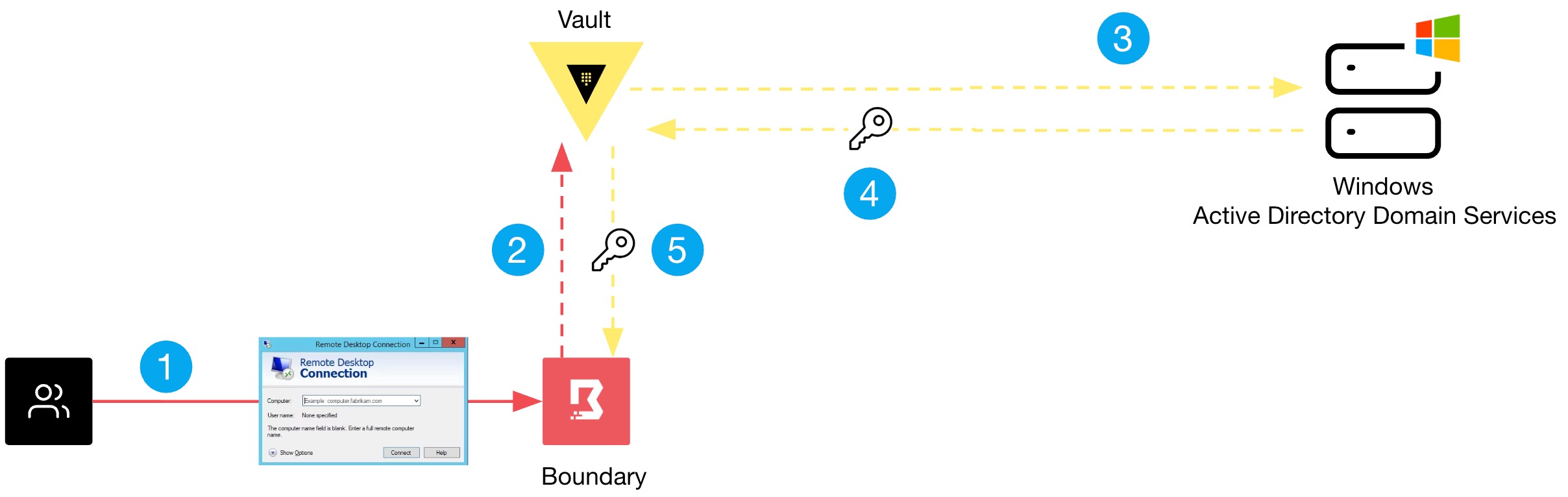
HashiCorp Boundary fundamentally changes the remote access paradigm. It acts as a gateway that authenticates users, checks authorization policies, and then brokers a session directly to the target Windows machine—without granting network‑level access. Boundary can integrate with existing identity providers (e.g., Okta, Azure AD) and supports session recording for audit compliance. It also manages credentials on behalf of the user, injecting them dynamically into the session so the user never sees the password. This decouples access from the underlying network, making lateral movement impossible. Boundary is designed for dynamic environments where IPs change frequently.
8. Vault Integration for Dynamic Credentials
Boundary works hand‑in‑hand with HashiCorp Vault to eliminate static credentials entirely. Vault can generate dynamic, time‑limited credentials for Windows machines via Active Directory or local accounts. When a user requests access through Boundary, Vault automatically creates a new, unique credential, which Boundary injects into the session. After the session ends—or after a configurable TTL—the credential is revoked. This ensures that each session uses a one‑time secret, rendering password theft useless. The combination of Boundary and Vault provides a seamless, zero‑trust experience with minimal operational overhead.
9. Practical Configuration Steps for Testing
To test this solution, start by deploying Boundary and Vault in your environment. Configure a target Windows machine—for example, a domain‑joined server—with the Vault agent that can generate dynamic credentials. Create a credential store in Boundary linked to Vault, and define a target resource pointing to the Windows machine. Next, set up an authorization policy that allows a specific user group to access that target. Finally, test by having a user connect via Boundary’s CLI or desktop client—they will be authenticated and given a direct, credential‑injected session. Detailed step‑by‑step guides are available in the official documentation.
10. Realizing the Operational and Security Benefits
Adopting Boundary and Vault transforms the security posture of Windows environments. Static credentials are replaced with dynamic, session‑limited secrets; broad VPN access is replaced with resource‑specific brokered sessions; and audit trails become actionable because every session is tied to a user identity. Operational overhead is reduced because credential rotation and access provisioning are automated. The result is a significant reduction in credential exposure, lateral movement risk, and management complexity. For CISO, DevOps, and security teams, this model provides a practical path toward zero‑trust for Windows remote access.
By addressing both the credential and access challenges together, organizations can move from a brittle, static model to a modern, identity‑centered one. Start with a pilot, measure the impact, and scale gradually. The future of Windows security lies in ephemeral credentials and identity‑based access—and Boundary and Vault make that future achievable today.
Related Articles
- 5 Essential Facts About the Franklin Expedition's Latest DNA Identifications
- Unpatched 2020 Windows Bug Exploited by New MiniPlasma Attack Tool
- Defending Against Geofenced PDF Phishing and Cobalt Strike: A Guide to Ghostwriter Tactics
- 10 Critical Data Sources for Cyber Threat Detection Outside the Endpoint
- Massive Data Breach at Medtronic Exposes 9 Million Records; Healthcare Sector on High Alert
- Brazilian DDoS Protection Firm's Infrastructure Hijacked to Attack Local ISPs
- How to Safeguard Your Enterprise from Shadow AI Agents with Microsoft Agent 365
- Yarbo's Promise: A Detailed Plan to Secure Their Robot Mowers After Critical Vulnerability