Global Gender Gap in GenAI Skills Narrows, But Wealthy Nations Lag: Coursera
Women around the world are closing the gender gap in generative AI (GenAI) skills faster than ever, but progress is uneven, with several wealthy English-speaking nations actually falling behind, according to a new report from online learning platform Coursera.
The report, released ahead of International Women’s Day, shows that women now account for 36% of all GenAI course enrollments on Coursera globally, up from 32% just one year ago. Among enterprise learners, the share jumped from 36% to 42% over the same period, signaling a rapid acceleration in female participation.
“The data is clear: women are not just catching up, they are becoming an increasingly powerful force in the GenAI workforce,” said Marni Baker Stein, Coursera’s chief content officer. “But the gap is far from closed, and in some of the world’s most advanced economies, we are actually seeing a setback.”
Key Findings
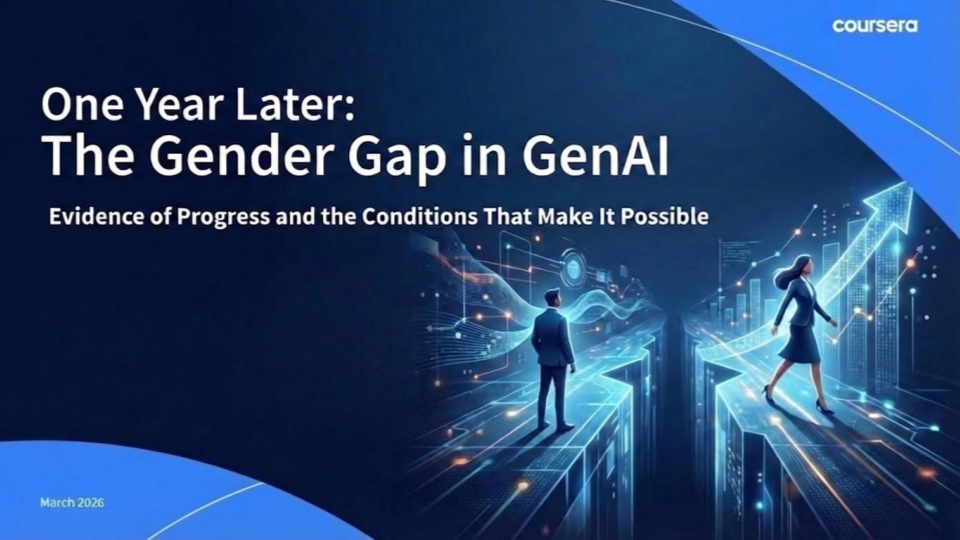
The One Year Later: The Gender Gap in GenAI report, a follow-up to Coursera’s original analysis in 2024, examines enrollment trends across more than 100 countries.
- Global progress: Women’s share of total GenAI enrollments rose from 32% to 36% year-over-year.
- Enterprise gains: In corporate learning, women now make up 42% of GenAI enrollments, up from 36%.
- Regional leaders: Latin American nations, notably Peru, Mexico, and Colombia, have nearly doubled their female GenAI enrollment share. In Asia, Uzbekistan saw an 8.8 percentage point increase, and India posted a 2.2 point rise.
- Developed nation decline: The United States (-0.9 percentage points), Canada (-1.0), the United Kingdom (-1.8), Spain (-1.1), and Germany (-0.2) all saw women’s share of GenAI enrollments shrink.
The report attributes the variance to differences in access to training programs, cultural attitudes, and corporate policies.
Background
GenAI is projected to add up to $22.3 trillion to the global economy by 2030, according to IDC research. Yet women remain underrepresented in the skills needed to drive that growth. Coursera’s original gender gap report last year found that women accounted for just 32% of GenAI enrollments.
The new data shows that many emerging economies are making faster progress than established ones. “Countries like Peru and Uzbekistan are showing the world that proactive investment in female digital skills can produce rapid results,” said Baker Stein.
What This Means
The trend raises critical questions about economic equity. If developed nations continue to see declining female participation in GenAI, they risk exacerbating existing wealth and opportunity gaps. “The countries that fail to include women in the GenAI revolution will be the ones left behind when the economic windfall arrives,” warned Baker Stein.
For companies and governments, the report underscores the need for targeted training programs, mentorship, and policies that address barriers such as bias, time constraints, and lack of confidence. In enterprise settings, where female enrollment is rising, structured learning incentives appear to be working.
“This is not just a social imperative; it is an economic one,” said Baker Stein. “Closing the gender gap in GenAI skills is essential to ensuring that the $22 trillion opportunity benefits everyone, not just a privileged few.”
The report also highlights the importance of regional strategies. In Latin America and parts of Asia, cultural shifts and government-led upskilling initiatives are driving change. In wealthier nations, renewed efforts are needed to reverse the backslide.
As International Women’s Day approaches, the message from the data is both hopeful and urgent: progress is possible, but it is far from guaranteed. The next year will be critical in determining whether the narrowing gap becomes a lasting trend or a temporary anomaly.
Related Articles
- Automating OSINT Investigations: A Q&A Guide to Building an AI Agent in Python
- Kuaishou’s SRPO Slashes Training Steps by 90% While Matching DeepSeek-R1-Zero in Math and Code
- How to Navigate Emerging AI Job Roles: From Evangelists to Gig Workers
- Your Gateway to Native macOS App Development: The macOS Apprentice Series
- 7 Essential Insights for Getting Started with Django: Why This 'Boring' Framework Is a Developer's Delight
- Getting Started with AWS's New Agentic AI Capabilities: A Guide to Amazon Quick and Amazon Connect
- Fedora’s AI Desktop Plan Derailed After Council Reversals and Community Uproar
- Unlocking Database Potential: How AI Transforms Management and Querying