Meta's Updated Approach to End-to-End Encrypted Backup Security
Introduction
Meta has been steadily advancing the security of its messaging platforms, particularly with regard to end-to-end encrypted backups for WhatsApp and Messenger. The company recently introduced new measures to bolster the underlying infrastructure that protects user data when backups are stored in the cloud. This article explores the core components of Meta's strategy, including the HSM-based Backup Key Vault, over-the-air fleet key distribution, and a renewed commitment to transparency.
The HSM-Based Backup Key Vault Foundation
At the heart of Meta's encrypted backup system lies the HSM-based Backup Key Vault, a solution designed to ensure that users' message histories remain private even from Meta itself. The vault employs tamper-resistant hardware security modules (HSMs) to store the recovery codes that people set to protect their backups. These recovery codes are never accessible to Meta, cloud storage providers, or any third party.
The vault operates as a geographically distributed fleet spread across multiple data centers. To maintain resilience and consistency, it uses a majority-consensus replication protocol. This setup ensures that even if some HSMs fail, the recovery codes remain available through the remaining nodes, while still preventing any single entity from compromising the system.
Earlier this year, Meta made it simpler for users to encrypt their backups using passkeys. Now, the company is building on that foundation with two key updates: over-the-air fleet key distribution for Messenger and a promise to publish evidence of secure fleet deployments.
Over-the-Air Fleet Key Distribution for Messenger
One of the challenges in maintaining end-to-end encrypted backups is ensuring that clients can verify they are communicating with a legitimate HSM fleet. In WhatsApp, the fleet's public keys are hardcoded into the application, which works well for that platform. However, Messenger required a more flexible approach because new HSM fleets may be deployed without requiring an app update.
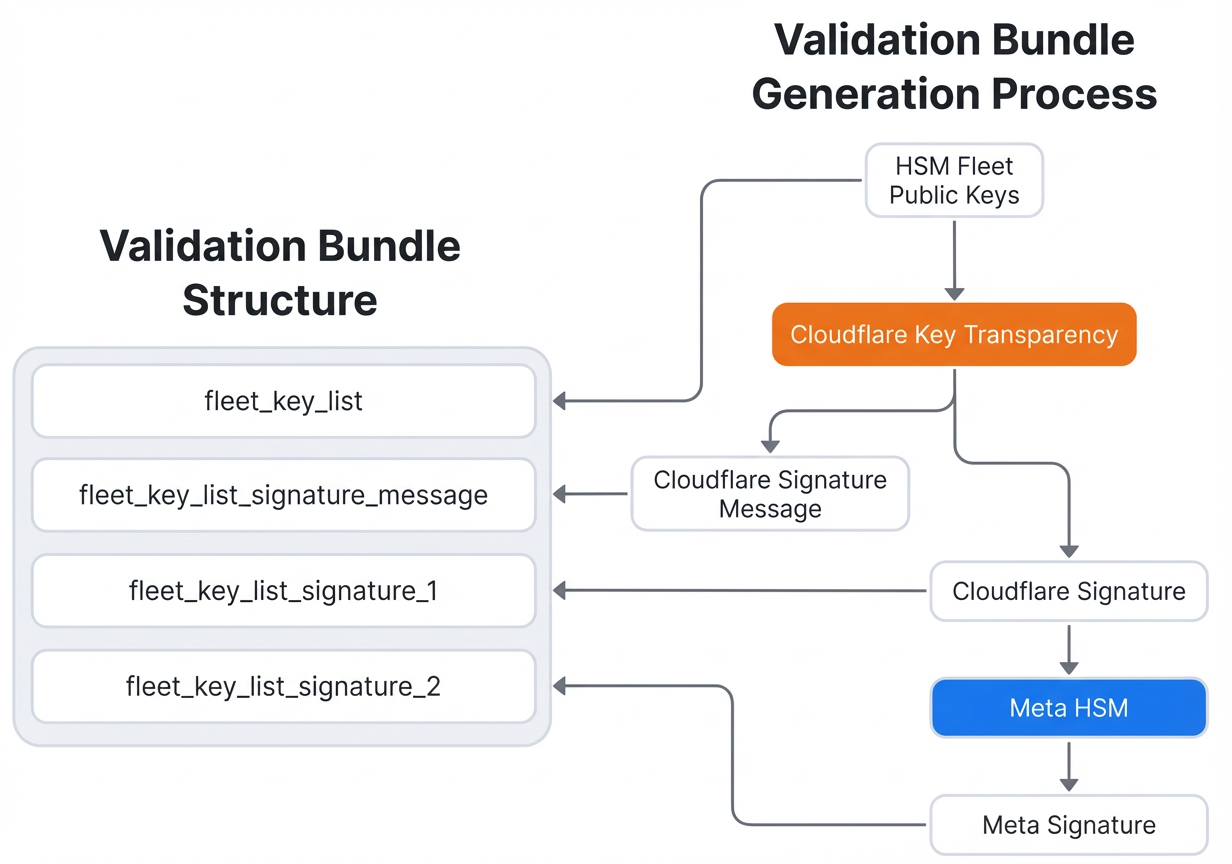
To address this, Meta built a mechanism to distribute fleet public keys over the air as part of the HSM response. The keys are delivered inside a validation bundle that is signed by Cloudflare and then counter-signed by Meta. This dual-signature provides independent cryptographic proof that the keys are authentic and have not been tampered with. Cloudflare also maintains an audit log of every validation bundle issued, offering an additional layer of accountability.
Clients validate these fleet keys before establishing a session, ensuring that they are connecting to a genuine HSM fleet. The complete validation protocol is described in detail in Meta's whitepaper, "Security of End-To-End Encrypted Backups." This approach allows Messenger to deploy new HSM fleets quickly and securely, without forcing users or developers to update the app every time.
Commitment to Transparency in Fleet Deployments
Transparency is critical for building trust in any security system. Meta acknowledges that demonstrating the HSM fleet operates as designed is essential to proving that Meta cannot access users' encrypted backups. The company has now pledged to publish evidence of the secure deployment of each new HSM fleet on its engineering blog.
New fleet deployments are rare — typically occurring only every few years. By making the deployment evidence public, Meta gives users and security researchers the opportunity to verify that the system is configured correctly. Anyone can follow the audit steps outlined in the aforementioned whitepaper to confirm that each new fleet is deployed in a secure manner. This move cements Meta's leadership in the space of secure encrypted backups and provides a model for other companies to follow.
Conclusion
Meta's latest updates to its end-to-end encrypted backup infrastructure represent a significant step forward in protecting user privacy. The HSM-based Backup Key Vault remains the cornerstone, while the introduction of over-the-air fleet key distribution for Messenger adds flexibility without sacrificing security. Combined with a renewed transparency commitment, these changes ensure that users can trust that their backup data remains truly private — even from the company that runs the service.
For those interested in the technical details, Meta encourages reading the full whitepaper, "Security of End-To-End Encrypted Backups," which provides a comprehensive specification of the HSM-based Backup Key Vault and all associated protocols.
Related Articles
- The Hidden Danger: Why Using Your Email as a Login Exposes You to Hackers
- How to Identify and Mitigate CVE-2026-0300: PAN-OS Captive Portal Buffer Overflow Vulnerability
- Python Ships Urgent Bugfix Releases: Version 3.14.2 and 3.13.11 Address Regressions and Security Vulnerabilities
- A Practical How-To Guide: Protecting Against SMS Blaster Scams, OpenEMR Security Flaws, and the Roblox Hack Epidemic
- Anthropic’s Mythos AI: Autonomous Hacking Tool Sparks Urgent Cybersecurity Debate
- 5 Critical Lessons from the Retracted Instructure Data Breach Report
- Unpatched 2020 Windows Bug Exploited: MiniPlasma Code Goes Public
- Securing vSphere Against BRICKSTORM: Key Questions and Answers