How to Deploy Reinforcement Learning-Controlled Autonomous Vehicles for Traffic Smoothing: A Practical Guide
A step-by-step guide to deploying reinforcement learning-controlled autonomous vehicles for smoothing highway traffic, from simulation to 100-car real-world experiment.
Introduction
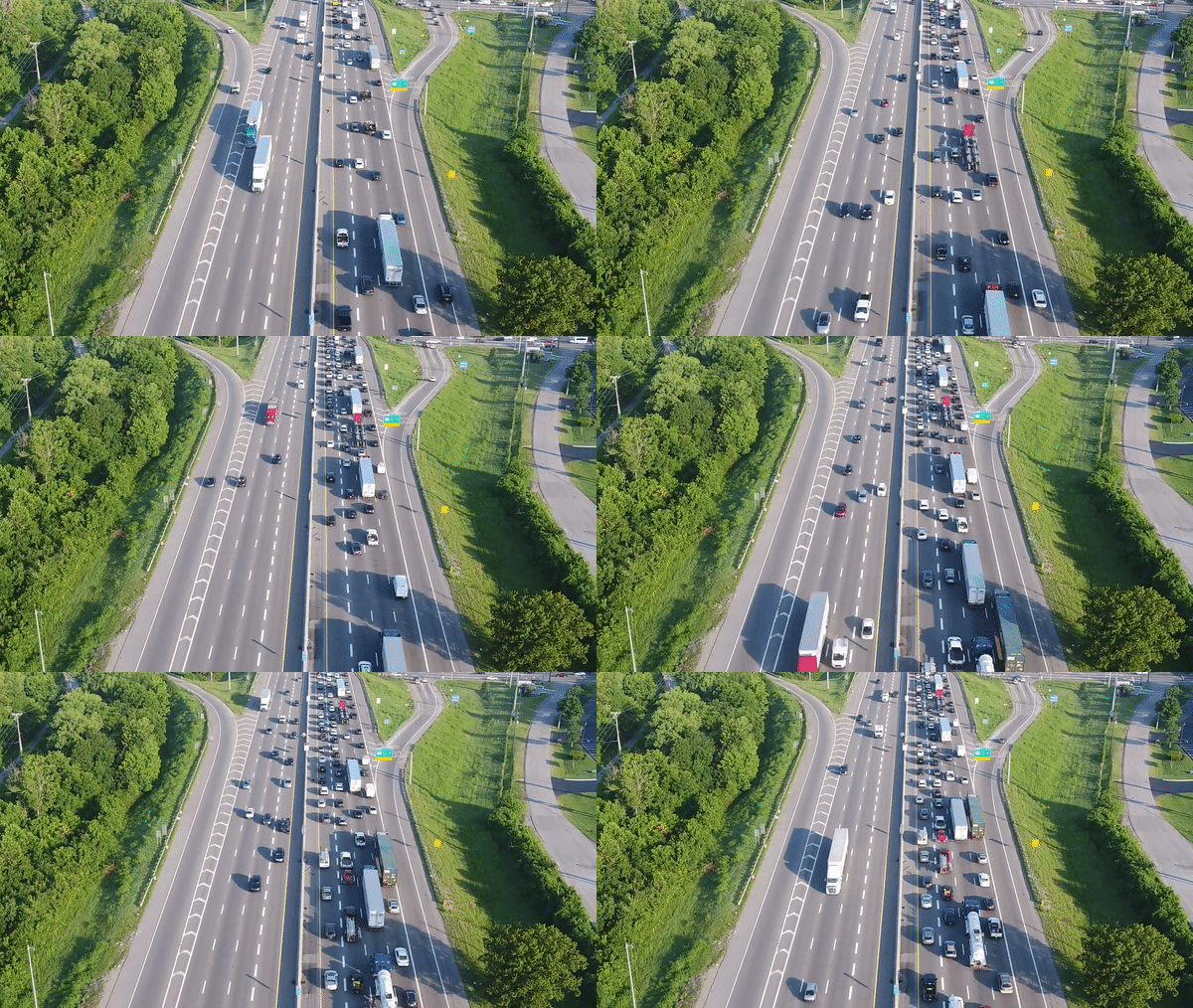
Stop-and-go waves—those frustrating, seemingly random traffic slowdowns—are a common bane for drivers on busy highways. They emerge from small fluctuations in human driving behavior that amplify into large oscillations, wasting fuel and increasing emissions. Research has shown that a small proportion of well-controlled autonomous vehicles (AVs) can dampen these waves, smoothing traffic for everyone. This guide walks you through the process of scaling up reinforcement learning (RL) controllers from simulation to real-world deployment, based on a 100-AV highway experiment. You'll learn the key steps: understanding the problem, building simulations, training controllers, and deploying them safely on public roads.
What You Need
- Reinforcement learning expertise – Familiarity with RL algorithms (e.g., PPO, SAC) and training pipelines.
- Traffic simulation software – A data-driven, fast microsimulation (e.g., SUMO, custom Python simulator) capable of modeling human driving behavior and AVs.
- Autonomous vehicle platform – A fleet of vehicles with standard radar sensors and control interfaces (e.g., steer-by-wire, throttle control).
- Computing resources – Servers or cloud instances for training RL agents (GPUs recommended).
- Safety and validation tools – Formal verification methods, simulation-based testing, and real-time monitoring.
- Regulatory approvals – Permissions from transportation authorities for on-road testing.
Step-by-Step Guide
Step 1: Understand the Phantom Jam Problem
Before deploying AVs, you must grasp why stop-and-go waves occur. They start with minor speed fluctuations that get amplified by human reaction delays. When a driver brakes slightly, the following driver brakes a bit harder, and the wave grows as it travels backward. This phenomenon is captured by the fundamental diagram of traffic flow, which shows that at high density, small perturbations can trigger traffic jams. To mitigate them, your AVs must act as dissipators by maintaining smoother trajectories and proactively adjusting speed to prevent amplification. Study the scientific literature on traffic flow theory and previous RL traffic smoothing work (e.g., the 100-AV experiment).
Step 2: Build a High-Fidelity, Data-Driven Simulation
RL requires a simulated environment for training. Create a microsimulation that replicates realistic highway traffic—including human drivers with reaction delays, speed fluctuations, and car-following models (e.g., Intelligent Driver Model). Use real traffic data (from loop detectors or probes) to calibrate the simulation so it reproduces stop-and-go patterns. The simulation must be fast enough to run many episodes—optimize by using parallelization or simplified vehicle dynamics. Ensure the simulation exposes an interface for RL agents to control AVs (acceleration, braking) and provides rewards (e.g., negative fuel consumption, throughput penalties).
Step 3: Design the RL Reward Function and Safety Constraints
The core of training is the reward function. Your objective: minimize stop-and-go waves while maintaining throughput and safety. A typical reward might be a weighted sum of:
- Fuel efficiency – Negative of instantaneous fuel consumption (proportional to acceleration).
- Smoothness – Penalize harsh accelerations/decelerations.
- Throughput – Reward maintaining high average speed.
- Safety – Add a large penalty for collisions or near-misses.
Include constraints: AVs must not exceed speed limits, maintain safe headway, and avoid sudden maneuvers. Use a safe RL framework (e.g., Lagrangian methods) to enforce constraints during training.
Step 4: Train the RL Controllers in Simulation
With the simulation and reward function ready, train your RL agents. Use a policy gradient algorithm (e.g., PPO) suitable for continuous control. For the 100-AV deployment, train a single policy that acts as a decentralized controller—each AV runs the same policy using only its own radar observations (distance to lead vehicle, relative speed, etc.). Run training in parallel on multiple CPUs/GPUs. Monitor training curves (reward, episode length) and validate performance on hold-out traffic scenarios. The trained policy should generalize to different traffic densities and human driver behaviors. This step may take weeks; be patient and iterate on reward design if training stagnates.
Step 5: Validate Controllers in Simulated Edge Cases
Before real-world deployment, rigorously test the trained controllers in simulation under extreme conditions: sudden cut-ins, emergency braking, merging traffic, adverse weather, sensor noise. Use formal verification tools to check that the policy never violates safety constraints (e.g., minimum time-to-collision). Simulate failures of communication or perception to ensure graceful degradation. The goal is to build confidence that the controllers are safe enough for on-road testing.
Step 6: Prepare the AV Fleet for Deployment
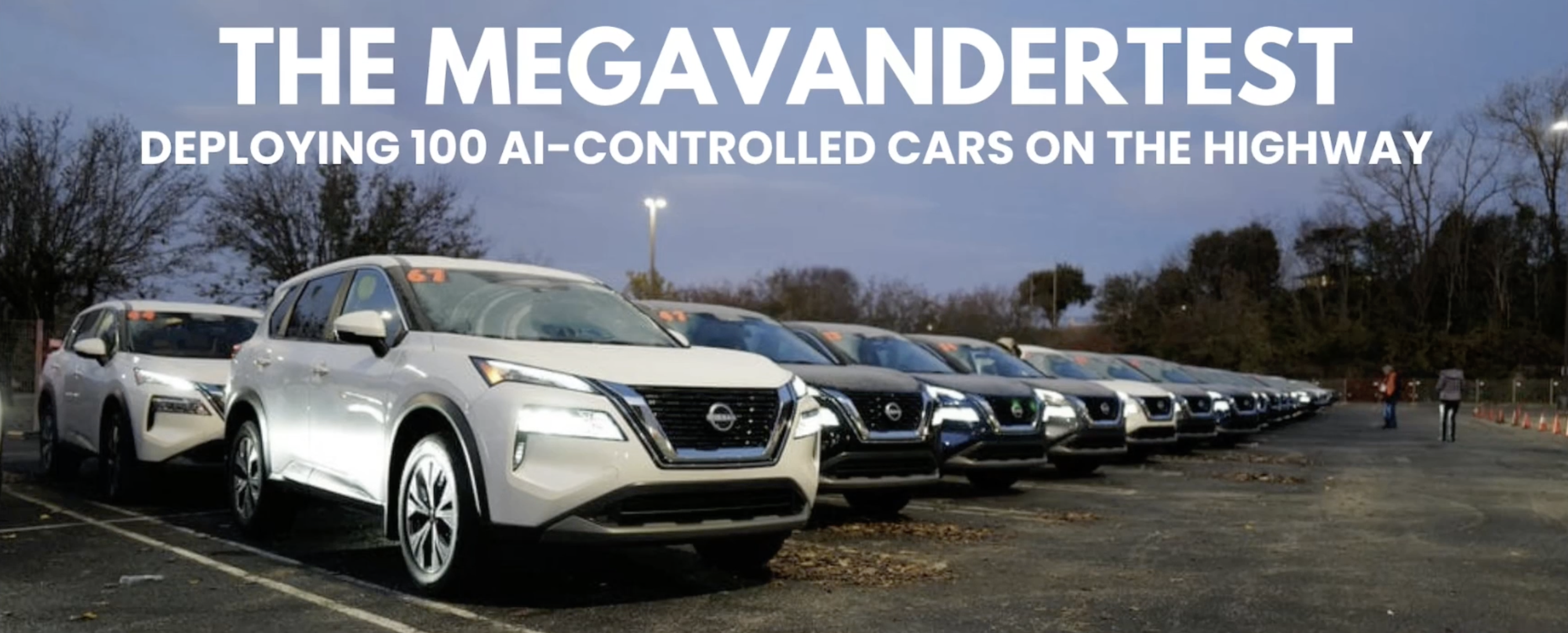
Equip a fleet of vehicles (e.g., 100 cars) with the necessary hardware: radar sensors for detecting surrounding vehicles, GPS for localization, and actuators for drive-by-wire control. Install the trained RL policy on an onboard computer (e.g., NVIDIA Jetson, industrial PC). Ensure the AVs can communicate with each other? In a decentralized setup, no vehicle-to-vehicle communication is required—each AV operates independently. Conduct closed-course tests to verify that the hardware interfaces work correctly with the RL controller.
Step 7: Obtain Regulatory Approvals and Plan the Field Experiment
Scaling up to 100 AVs on public roads requires coordination with local transportation authorities. Submit a detailed test plan: route (e.g., a 10-mile highway stretch), time (off-peak initially), safety drivers in every AV, emergency procedures, and data logging. Obtain necessary permits and insurance. Arrange for traffic monitoring (e.g., drones, fixed cameras) to evaluate impact on traffic flow.
Step 8: Deploy the RL Controllers on Real Highways
On the day of deployment, have a command center monitor all AVs in real time. Instruct safety drivers to remain alert and take over if the RL policy behaves unexpectedly. Start with a small number of AVs (e.g., 10) and gradually increase to 100 as confidence grows. Let the AVs run for several hours to collect data. The controllers will attempt to smooth stop-and-go waves by maintaining a steady speed, anticipating braking, and avoiding unnecessary accelerations. Expect to see reduced fuel consumption for all vehicles (measured via OBD-II readers) and fewer speed oscillations.
Step 9: Analyze Results and Iterate
After the experiment, compare traffic metrics (average speed, fuel consumption, number of stop-and-go events) with a control period without AVs. If results are unsatisfactory, go back to simulation to refine the reward function or training algorithm. Common issues include overly conservative driving (reducing throughput) or aggressive oscillations. Use the real-world data to improve simulation fidelity and retrain. The process is iterative—each deployment teaches new lessons.
Tips for Success
- Start small: Begin with 1-2 AVs in simulation and real traffic before scaling to 100.
- Prioritize safety: Always include a human safety driver and fail-safe mechanisms. Never rely solely on RL for safety-critical decisions.
- Use radar over cameras: Radar works in all weather and is less computationally intensive—ideal for decentralized control.
- Embrace simulation: The quality of your simulation determines the quality of your final controller. Invest time in calibrating it with real data.
- Collaborate: Partner with traffic engineers, vehicle manufacturers, and regulators to navigate the complex deployment ecosystem.
- Share your data: Open-sourcing your simulation and RL policies can accelerate research and build trust.
- Be patient: Real-world RL deployment is hard. Expect failures and treat them as learning opportunities.
By following these steps, you can replicate the 100-AV experiment and contribute to a future where traffic jams are a thing of the past. For more details, refer to the original paper on scaling up RL for traffic smoothing.